Methodology
 Power Sector Competitiveness Dashboard (PSCD) Methodology Version 1.0 (December 2025)
How to Cite the Power Sector Competitiveness Dashboard
Please use the following citation when using, downloading, or referencing the PSCD dataset:
Parajon, E., Gowdy, T.M., Weintraut, B., Deshmukh, M., Ewing, J., Zwane, A.P. 2025. Power Sector Competitiveness Dashboard (PSCD) Dataset, Version 1.0. Nicholas Institute for Energy, Environment & Sustainability, Duke University.
Available at: https://nicholasinstitute.duke.edu/project/power-sector-competitiveness-dashboard
When citing the PSCD Methodology, please use the citation below. This citation is only needed when referencing the scoring framework, indicator construction, or other concepts drawn directly from the methodology:
Parajon, E., Gowdy, T.M., Weintraut, B., Deshmukh, M., Ewing, J., Zwane, A.P. 2025. Power Sector Competitiveness Dashboard (PSCD): Methodology Version 1.0. Nicholas Institute for Energy, Environment & Sustainability, Duke University.
Available at: https://nicholasinstitute.duke.edu/project/power-sector-competitiveness-dashboard/methodology
Definitions
Category: Consumer
Third-Party Power Purchase Agreements
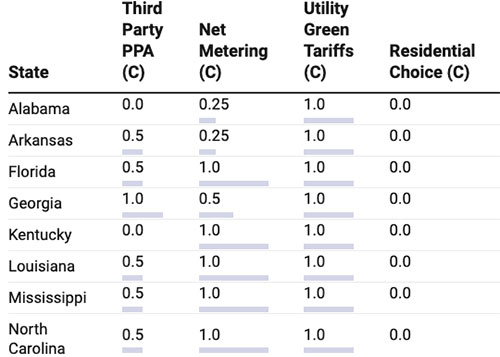
This indicator captures whether states permit customers to enter into agreements with third-party developers that install and operate energy systems on the customer’s property and sell power generated to the customer at a contracted rate.
Net Metering
This indicator evaluates the extent to which states enable or limit billing systems that provide credits to owners of distributed generation (e.g., solar) that return excess electricity generation to the grid.
Utility Green Tariffs
This indicator measures the prevalence of the largest utilities in a state that allow large commercial and industrial customers to buy electricity generated from renewable energy projects at a special rate.
Residential Retail Choice
This indicator evaluates whether state policy enables residential customers to choose alternative electricity suppliers other than the incumbent utility.
Commercial and Industrial Retail Choice
This indicator evaluates whether state policy enables commercial and industrial customers to choose alternative electricity suppliers other than the incumbent utility.
Category: Structure
Option for Municipal Ownership of Utilities
This indicator assesses whether state policy authorizes municipalities to form their own utility.
Presence of a Consumer Advocate
This indicator evaluates whether states have a consumer advocate office that represents consumer interests in utility proceedings.
Community Choice Aggregation
This indicator measures the presence, or lack thereof, of state policy enabling municipal choice in procuring electricity from a provider other than the incumbent utility on behalf of the area’s consumers.
Customer Concentration - All Utilities
This indicator assesses how concentrated each state’s utility market overall is by calculating the Herfindahl-Hirschman Index (HHI) from customer counts, following Department of Justice antitrust guidelines.
Customer Concentration – Generation
This indicator assesses how concentrated each state’s utility generation capacity is by calculating the Herfindahl-Hirschman Index (HHI) from customer counts and Department of Justice antitrust guidelines.
Procurement Requirements
This indicator measures the presence, or lack thereof, of state rules on how utilities may acquire new generation sources. This can include requiring or encouraging competitive procurement for all or some new generation in lieu of defaulting to a default utility-led approach.
Interconnection Standards
This indicator measures the presence, or lack thereof, of a state interconnection standard or guideline for investor-owned utilities, or in the absence of a state policy, whether the state’s largest utility has one.
Category: Regional Market
Market Participation
This indicator evaluates the extent that a state’s utility(ies) participates in a bilateral trading market, such as the Southeast Energy Exchange Market (SEEM), and/or a wholesale electricity market such as a regional transmission organization (RTO)/independent system operator (ISO).
Civil Society Participation Role in Wholesale Market
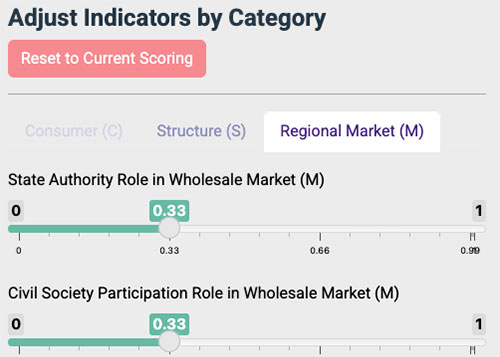
This indicator measures on the ability for civil society organizations (e.g. environmental organizations) to participate within the governance structure of a wholesale market (regional transmission organization (RTO) / independent system operator (ISO)), when states participate in such a market, formalizing multi-actor participation in the process.
State Authority Role in Wholesale Market
This indicator measures a state's role within the governance structure of a wholesale market (regional transmission organization (RTO) / independent system operator (ISO)), when states participate in such a market, formalizing multi-actor participation in the process.
Additional Resources
This collection of complementary electricity sector competitiveness dashboards and/or policy trackers for additional context. We do not endorse or provide any guarantees about the data or information listed below.
- Freeing the Grid - Interconnection Grades (Vote Solar and the Interstate Renewable Energy Council)
- Database of State Incentives for Renewables & Efficiency, DSIRE (North Carolina State University)
- How to Build Clean Energy Portfolios (RMI)
- State-By-State Scorecard on Electricity Competition (R Street)