
The Power Sector Competitiveness Dashboard offers a set of indicators that characterize competitiveness of electricity markets in the Southeastern United States.
State policies, regulatory structures, and market arrangements shape the interaction between consumers, communities, and utilities. This Dashboard aggregates indicators across a continuum of competitiveness into one cohesive platform. This provides a snapshot of current competitiveness conditions, features policy examples, and highlights areas of difference across states.
This dashboard primarily covers the southeastern states of Alabama, Arkansas, Florida, Georgia, Kentucky, Louisiana, Mississippi, North Carolina, South Carolina, Tennessee, Virginia, and West Virginia. Click on any state for detailed information.
This project is led by Duke University’s Nicholas Institute for Energy, Environment & Sustainability. This project is supported by the Arthur M. Blank Family Foundation and is produced in concert with complementary work being led by World Resources Institute.
What factors contribute to scoring?
For this dashboard, competitiveness refers to the extent which state policies, regulatory structures, and market arrangements create conditions that can support or hinder consumer and community choice, distributed generation, multi-actor market participation, investment decision-making, and sharing of regional resources.
Competitiveness is presented as a continuum of practices that influence how utilities, regulators, producers, and consumers interact.

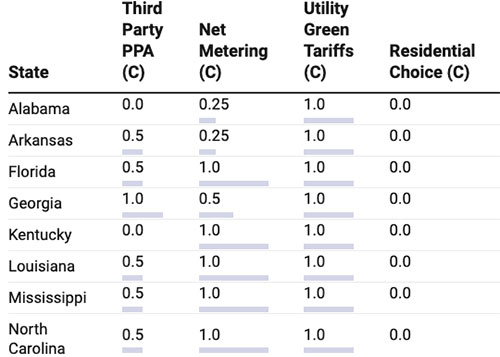
Consumer category: Captures consumer facing policies and programs that empower individual consumers or large energy users to make decisions about their electricity usage, providers, or rate structure.

Structure category: Captures regulatory frameworks and utility sector features that impact or characterize the state electricity sector broadly.

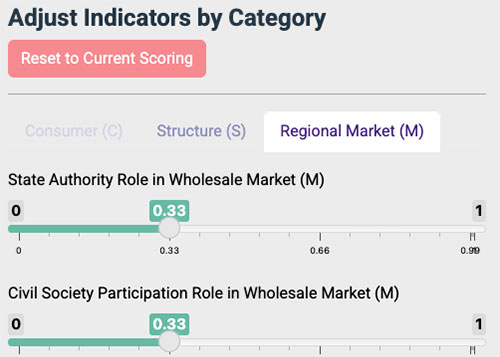
Regional Market category: Captures participation in multi-state energy markets and transmission organizations that manage large-scale electricity dispatch and components of their governance that support broad involvement.