

Publications

Modernizing Heat Alerts in North Carolina: A Health-Based Framework for Subregional Risk Communication
In response to rising extreme heat risks across North Carolina, this study refines and evaluates the North Carolina Division of Public Health (NCDPH) Climate and Health Program’s Heat Health Alert System (HHAS), a health-based warning framework first introduced in 2018.

Extreme Heat Risk Governance Framework and Toolkit
Extreme heat is one of the world’s most dangerous climate challenges, threatening health, livelihoods, and infrastructure. This new resource provides practical tools for national and local authorities to strengthen coordination, planning, and investment to protect people and systems from escalating heat impacts.
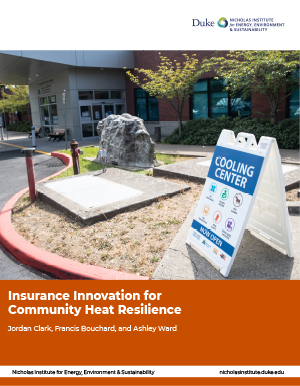
Insurance Innovation for Community Heat Resilience
Traditional relief programs following extreme weather, including extreme heat, are slow and reactive. What is needed is an approach that can quickly deploy assistance when temperatures spike. That is where parametric insurance—a financial tool that automatically releases funds when a specific weather threshold is exceeded—might be part of the solution. This report explores the feasibility of a parametric model of insurance for extreme heat using North Carolina as a case study.

The Hidden Cost of Heat: Tracking Losses in Crop Insurance
As farmers struggle with lower yields, many rely on the Federal Crop Insurance Program to recover a portion of what they’ve lost. These insurance claims offer a window into the hidden costs of rising heat on agriculture.

The Hidden Cost of Heat: Impact on Local Economies
Heat exposure has increased over the last two decades, significantly reducing workforce efficiency and leading to substantial financial losses for companies and communities alike. By comparing current conditions with what productivity would look like at cooler temperatures, this research reveals the hidden extent of heat’s impact on workability and the economy.

Counting the Cost: Quantifying the Rising Impacts of Heat-Related Productivity Losses in the United States (2001–2023)
This study quantifies how rising temperatures have eroded US economic productivity over the past two decades, especially in heat-exposed industries. Using high-resolution hourly weather data and multiple labor productivity models, the authors estimate that heat-related productivity losses grew from a model average of $130 billion in 2001 to $220 billion in 2023.

Heat Legislation in the Southeast: Gaps, Innovations, and Opportunities
High humidity, widespread energy poverty, and extensive outdoor labor converge to make the Southeast particularly susceptible to extreme heat’s ill effects. While there have been efforts to review heat governance and local government responses to heat, this report provides the first multistate review of extreme heat–related legislation across 11 Southeastern states.

Engaging Communities, Aligning Strategies, and Scaling Solutions: A Report from HeatWise DC
HeatWise DC—a continuation of the HeatWise Policy Partnership launched in 2024—brought together 62 cross-sectoral leaders to confront the rising threat of extreme heat. Held in Washington, DC, the three-day event focused on rural vulnerability; national security and defense; and finance, insurance, and industry. Participants highlighted that while there are existing tools and knowledge to address heat, policy, funding, and delivery systems remain disconnected from the realities on the ground.

The Hidden Cost of Heat: Impacts to Bridges
Extreme heat is increasingly causing disruptions to critical infrastructure across sectors. With more frequent and intense heatwaves, infrastructure designed for milder conditions is being stressed beyond its capacity, resulting in higher maintenance demands and limited effectiveness of mitigation measures.

Stocktake Report: Heat Action Across United Nations Entities and International Organizations
This report examines the landscape of extreme heat management among United Nations entities and International Organizations for the first time, identifying challenges, opportunities, and strategies for improving collaboration and governance to support the United Nations Secretary-General’s Call to Action on Extreme Heat.