

Publications

Can Private Finance Save the World's Forests and Oceans?
To scale debt-for-nature swaps and related financial instruments, the G20 and COP30 must expand opportunities for credit enhancement, reform sovereign credit rating systems, employ conservation performance metrics, and improve stakeholder participation.
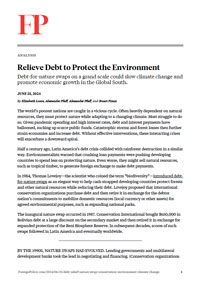
Relieve Debt to Protect the Environment
Debt-for-nature swaps on a grand scale could slow climate change and promote economic growth in the Global South.
 , and Stuart Pimm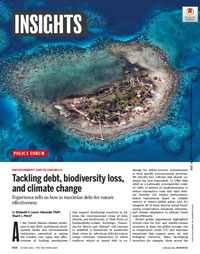
Tackling Debt, Biodiversity Loss, and Climate Change
Debt distress, biodiversity loss and climate change are interconnected crises for developing countries. A task force of multilateral development banks and environmental institutions is convening a task force to establish a framework to ameliorate these crises by reforming debt-for-nature swaps. The authors of this Policy Forum identify four reforms that should underpin the new framework.
, Stuart L. Pimm 
Financing Nature-Based Solutions via the Greenhouse Gas Reduction Fund
The $27 billion Greenhouse Gas Reduction Fund (GGRF) in the Inflation Reduction Act—particularly the $14 billion National Clean Investment Fund and $6 billion Clean Communities Investment Accelerator—represents a once-in-a-generation opportunity to leverage private capital for investments in environmental infrastructure and nature-based solutions, but the groundwork needs to be laid now. This document summarizes the relevant GGRF funds and their applicability for nature-based solutions.
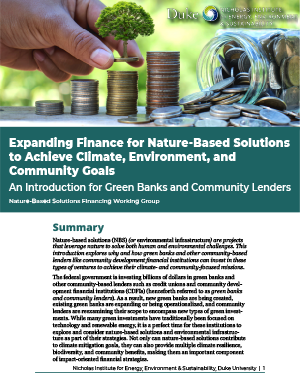
Expanding Finance for Nature-Based Solutions to Achieve Climate, Environment, and Community Goals: An Introduction for Green Banks and Community Lenders
There has been unprecedented recent government investment in nature-based solutions. This document lays out a vision that describes why nature-based solutions are relevant and important to green banks' and community development financial institutions' climate- and community-driven missions, and what types of projects these institutions might support.