

Publications

Identifying and Closing Gaps in Corporate Reporting of Ocean Impacts
As ocean industrialization accelerates, corporate transparency is increasingly seen as critical to improve governance. Yet little is known about how firms disclose their impacts on marine ecosystems. This study addresses that gap through a content analysis of sustainability and annual reports from 75 of the largest companies across 8 sectors of the ocean economy.

Advancing China’s Sustainable Blue Economy—Building Strong Policy Foundations for Ocean Accounting and Blue Finance
The global ocean economy is currently undergoing profound transformation. In the face of multiple challenges, the issue of sustainable ocean development has become a central concern for the international community. As a major maritime nation and a key player in the global ocean economy, China has responded to the call for sustainable development and is accelerating its transition toward a more sustainable blue economy (SBE).

Assessing the Financial Services Sector’s Leverage in Advancing a Sustainable Ocean Economy
Prior research suggests that the global financial services sector could influence the sustainability of the ocean economy, particularly with better information on companies’ externalities (Barbier 2023; Sumaila et al. 2021; Jouffray et al. 2019). This brief summarizes preliminary, non-peer-reviewed findings from ongoing research that explores the potential influence of the financial sector on the sustainability of the ocean economy. It aims to contribute to and inform policy discussions emerging from the United Nations Oceans Conference in June 2025.

Inspiring Women in Small-Scale Fisheries from Ocean to Table
Oceans@Duke Director Stephanie Rousso discusses her personal experience working with women fisherfolk to promote sea turtle conservation in an opinion for Frontiers in Ocean Sustainability. "Globally, women are blending traditional knowledge with modern science, taking on challenges head-on, and redefining what it means to work toward a sustainable ocean," she writes. "While these global initiatives are empowering women at a large scale, my personal journey has shown me how deeply transformative their contributions can be at the grassroots level."
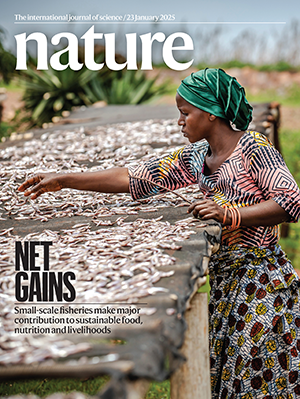
Illuminating the Multidimensional Contributions of Small-Scale Fisheries
Small-scale fisheries play a significant but overlooked role in global fisheries production and are key to addressing hunger and malnutrition while supporting livelihoods around the world, according to research featured on the cover of Nature. The data and methodology for this paper were produced within the framework of the Illuminating Hidden Harvests initiative conducted by the Food and Agriculture Organization of the United Nations, Duke University, and WorldFish.
, Nicolas L. Gutierrez, Nicole Franz, Maria del Mar Mancha-Cisneros, Giulia Gorelli, Alba Aguión, Simon Funge-Smith, Sarah Harper, Dave J. Mills, Gianluii Nico, Alex Tilley, Stefania Vannuccini, John Virdin, Lena Westlund, Edward H. Allison, Christopher M. Anderson, Andrew Baio, Joshua Cinner, Michael Fabinyi, Christina C. Hicks, Jeppe Kolding, Michael C. Melnychuk, Daniel Ovando, Ana M. Parma, James P. W. Robinson, and Shakuntala H. Thilsted
A Global Assessment of Preferential Access Areas for Small-Scale Fisheries
We provide the first global assessment of the status of preferential access areas (PAAs), a relatively understudied policy tool to govern small-scale fisheries. We find 44 countries, most of them of low or low-middle income, have established a total of 63 PAAs encompassing 3% of continental shelf area worldwide.
, John Virdin, Nicole Franz, Sarah DeLand, Bea Smith, Jesse Cleary, Tibor Vegh, and Patrick Halpin 
Citizen Science Enhances Understanding of Sea Turtle Distribution in the Gulf of California
Citizen science is a valuable tool for addressing spatial distribution gaps in endangered, migratory species, especially in data-limited regions. This paper examines how diverse community groups (coastal residents, SCUBA divers, and artisanal fishers) contribute to sea turtle distribution information in the Bay of La Paz, Baja California, Mexico. Though the sample size is small, the variety of sources and sighting types highlight the value of collaborative citizen science in complementing traditional research.

Improving Market-Based and Government-Run Adaptation Solutions for Mitigating Flood Risk Using Natural Infrastructure
The goal of this research is to understand the implications of using nature-based solutions, or natural infrastructure (NI), to mitigate the impacts of flooding. The two solutions I evaluate to supply NI are a program that financially incentivizes its supply by private landowners, and a government-run floodplain property acquisition program. This dissertation consists of three papers examining payments for ecosystem services (PES) programs in terms of enrollment, incentives, and outcomes.
Transdisciplinary Doctoral Training to Address Global Sustainability Challenges
Global sustainability challenges, such as climate change and the plastics crisis, converge across disciplines and involve diverse stakeholders. Given the magnitude and interconnected nature of sustainability challenges, problem-solvers must be trained across disciplines.

Opportunities, Tradeoffs, and Caveats for Private Sector Involvement in US Floodplain Buyout Programs
The United States has increasingly relied on government-administered floodplain buyout programs to reduce flood risk and remove flood-damaged dwellings from floodplains. However, high transaction costs and long administrative timelines dramatically hamper buyout program efficiency. This report derives financial efficiency thresholds suggesting situational advantages to both private- and government-run buyout programs and also evaluates alternative institutional structures for implementing buyouts and novel mechanisms for financing buyouts