

Publications

The Viability of Solar Mini-Grid Irrigation as a Replacement for Diesel Technology in Ethiopia
Pairing electric irrigation systems with mini-grids in communities that currently lack electricity has the potential to both increase the productivity and resilience of smallholder farms and contribute to rural electrification in Africa. This research develops a solar mini-grid irrigation viability model to assess the feasibility of such a technology setup.

Cold Chains, from Net to Fork: Evidence from Kenya on Livelihoods and Community Resilience
Small-scale fisheries in Kenya support more than 1.5 million livelihoods but face mounting climate and market shocks that threaten food security and income stability. Research led by Duke University and the University of Nairobi evaluated the Keep IT Cool model—a private enterprise linking fishing communities around Lake Victoria and Lake Turkana to higher value markets trough solar-powered cold storage and logistics.

Evaluating the Adaptation Benefits of Cold Storage and Market Connectivity for Kenyan Fisherfolk on Lake Turkana
Fishing plays a central role in the livelihoods and food security of many rural communities in Kenya, particularly around Lake Turkana, where climate variability, spoilage of catch, and limited market access have historically constrained economic opportunities. Keep IT Cool (KIC) is a social enterprise that provides solar refrigeration and cold chain logistics for smallholder chicken farmers and fisherfolk in Kenya.

Sustainability and Contribution of Household Biogas Plants to Energy Transition in Nepal
Household biogas can significantly contribute to sustainable energy transition by supporting the decarbonisation and modernization of the cooking energy sector. Nearly 450,000 household biogas plants were reported to have been installed in Nepal as of 2023. This study assesses their sustainability using large-scale household survey data combined with statistical analysis. The findings in this article inform recommendations to improve the performance and sustained use of household biogas systems in Nepal and other countries with similar geographical and socioeconomic conditions.

On the Back Burner: Experimental Evidence For Energy Transitions
A central challenge in the global transition to cleaner energy is how governments can design policies that deliver large social benefits while facing trade-offs in energy security, fiscal costs, and household adoption frictions. The authors studied this question in urban Nepal, where cooking is dominated by imported liquid petroleum gas (LPG), but abundant hydropower makes both large-scale electrification and improved energy security feasible.
 , and Manisha Pradhananga
Powering Livelihoods by Avoiding Household Damages: Household Willingness to Pay For Electricity Reliability in Sierra Leone
The authors estimate the marginal willingness to pay (WTP) for improved electricity service reliability in a nationally representative sample 1,047 grid or mini-grid connected households in Sierra Leone, using two complementary valuation approaches. Analyzing data from a discrete choice experiment, they find that, on average, households exhibit strong preferences for shorter outages; fewer daytime and evening outages, compared to nighttime outages; and prior notification, though there is heterogeneity in the relative weights ascribed to each of these attributes.

An Implementation Science Analysis of an Ethanol Cooking Fuel Promotion Project in Dar es Salaam, Tanzania
In this study, the authors conduct an implementation science analysis of Phase I of the “Promotion of Bio-Ethanol as Alternative Clean Fuel for Cooking in the United Republic of Tanzania” project, describing the roll-out of this market-based bioethanol stove program. Leveraging program administrative data, individual interviews, and focus group discussions, we apply the RE-AIM framework to evaluate the successes and limitations of the project.

Incentivizing Grid Reliability: A Framework for Performance-Linked Electricity Improvements in Low- and Middle-Income Countries
Reliable electricity is the foundation of modern economies and essential to social and human development. Without it, firms cannot expand, hospitals cannot operate safely, and households hesitate to invest in appliances and tools that improve daily life. It is reliability—not just connection—that unlocks the full promise of access: delivering jobs, growth, and opportunity. Yet across low- and middle-income countries (LMICs), ensuring electricity reliability has proven to be one of the most intractable energy systems challenges.
Jean Nahrae Lee, Ryan McCord, Robyn Meeks
, Dalia Patiño-Echeverri ,Manpreet Singh, Xander Slaski, Ruozi Song, Rafia Zaman, and Alix Peterson Zwane
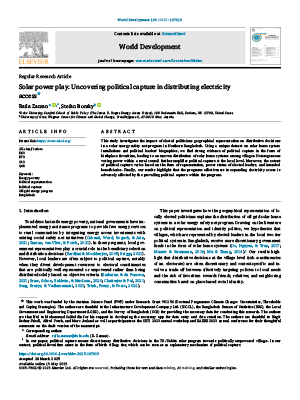
Solar Power Play: Uncovering Political Capture in Distributing Electricity Access
This study investigates the impact of elected politicians geographical representation on distributive decisions in a solar energy safety net program in Northern Bangladesh. Using a unique dataset on solar home system installations and political leaders’ biographies, we find strong evidence of political capture in the form of birthplace favoritism, leading to an uneven distribution of solar home systems among villages. Heterogeneous voting power within a rural council further amplifies political capture at the local level.
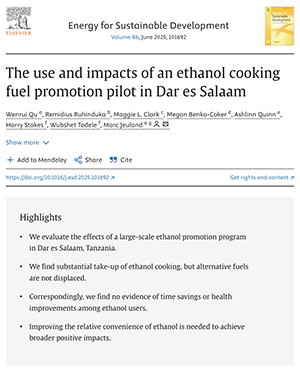
The Use and Impacts of an Ethanol Cooking Fuel Promotion Pilot in Dar es Salaam
The authors evaluated the effects of a large-scale ethanol cooking fuel promotion program in Dar es Salaam, Tanzania, and found substantial uptake of ethanol cooking. However, alternative fuels were not fully replaced under this scheme. The report concludes that improving the relative convenience of ethanol as a cooking fuel is needed to achieve broader positive impacts.