

Publications
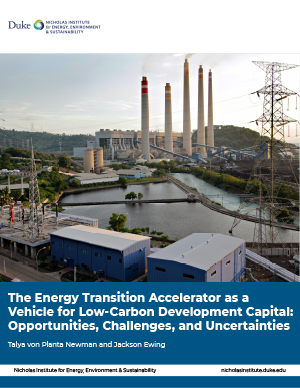
The Energy Transition Accelerator as a Vehicle for Low-Carbon Development Capital: Opportunities, Challenges, and Uncertainties
Addressing the dual needs of development and decarbonization in low- and middle-income countries requires significant increases in public and private investment and project implementation. Announced in 2022 by the US Department of State, The Rockefeller Foundation, and the Bezos Earth Fund, the Energy Transition Accelerator (ETA) aims to drive such increases by leveraging carbon credits as a sector-wide channel for energy transition finance.

Planning for Growing Electricity Demand During an Era of Uncertain Renewables and Climate Policy
Electricity demand growth has accelerated significantly, a trend that is expected to continue for at least the next 5 to 10 years and is driven by new technologies such as data centers and the expansion of the manufacturing and industrial base in the United States. This analysis uses a variety of integrated resource plans from utilities and other groups to estimate how overall electricity demand may change over the next decade in several scenarios.
The People’s Republic of China’s Emissions Trading Scheme: Origins, Characteristics, and Lessons for Greater Asia
The People’s Republic of China is using the national emissions trading scheme (ETS) as a tool to bend the country’s emissions curve while cleaning its domestic environment, driving innovation, and capturing a greater share of high-value segments of the global economy. This background paper for the Asia-Pacific Climate Report 2024: Catalyzing Finance and Policy Solutions first explores the origins of the ETS and then looks at its characteristics and performance.

Energy Transitions at a Crossroads: Balancing Growth, Decarbonization, and Development
Can low- and middle-income countries meet human development imperatives while decommissioning fossil fuel infrastructure or avoiding further fossil fuel development? A high-level panel at Climate Week NYC 2024—moderated by Jackson Ewing and featuring executive in residence Alix Peterson Zwane alongside global investment leaders—attempted to address just that.

Projecting Electricity-Sector Investments Under the Inflation Reduction Act: New Cost Assumptions and Interactions with EPA’s Greenhouse Gas Proposal
Energy Pathways USA, an initiative of the Nicholas Institute for Energy, Environment & Sustainability at Duke University, has released a report that offers new insights into US energy transition investments. This report comprehensively models the intersecting effects of the Inflation Reduction Act, clean electricity development cost increases, and the impacts of proposed US Environmental Protection Agency greenhouse gas regulations for fossil fuels.

The State of Blended Finance 2023: Climate Edition
This year’s edition of the State of Blended Finance published by Convergence once again focuses on climate. Climate change continues to be central to the blended finance market and to sustainable development more broadly. Jackson Ewing, director of energy and climate policy at the Nicholas Institute, and Jonathan Phillips, director of the James E. Rogers Energy Access Project at Duke, were among the experts and stakeholders interviewed for the report. Ewing and Phillips offered insights on Just Energy Transition Partnerships as a partnership model for mobilizing climate blended finance.
Carbon Pricing Leadership Report 2022/23
The annual Carbon Pricing Leadership Report complements the Carbon Pricing Leadership Coalition’s advocacy and networking activities by elevating thought leadership in the mitigation arena and sharing how partners across all sectors are putting a price on carbon and engaging in carbon markets to reduce their emissions. Jackson Ewing, director of energy and climate policy at the Nicholas Institute, contributed to the report with an opinion piece titled "Stakes Increase as Voluntary Carbon Markets and Climate Finance Converge."
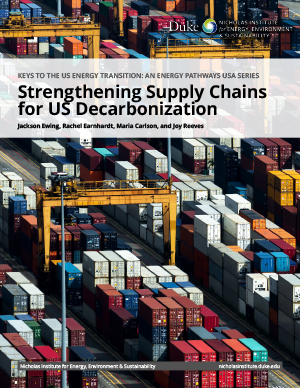
Strengthening Supply Chains for US Decarbonization
The 2022 Inflation Reduction Act provides new sources of capital and incentives for accelerating net-zero efforts. The law concurrently seeks to shift supply chains vital for US decarbonization to domestic sources and, more selectively, to links with free-trade partners. However, challenges abound. This policy paper responds by exploring opportunities inherent to rapidly creating just, low-carbon, and sustainable supply chains for key sectors of the US economy.
This report is part of Keys to the US Energy Transition: An Energy Pathways USA Series.
Pathways to Net-Zero for the US Energy Transition
What will it take to achieve a net-zero carbon emissions footprint for the US economy by 2050? This report from Energy Pathways USA helps strengthen the evidence base on what will be required for a robust US energy transition and elucidates key barriers and opportunities for reaching net-zero goals. The report also outlines future areas of focus for Energy Pathways USA, a Duke-based project that accelerates progress towards a net-zero carbon future by developing workable solutions with corporate partners across multiple key industries.
Climate Finance for Just Transitions
This paper investigates challenges in the international climate finance landscape through three issue areas: (1) aligning national climate strategies and international finance, (2) finding avenues for positive climate finance outcomes in an era of growing rivalry between Chinese and Group of Seven—particularly US—public financiers, and (3) reforming major climate finance practices and institutions to more effectively cater to the needs of LMIC stakeholders.