

Publications
Solar Power Play: Uncovering Political Capture in Distributing Electricity Access
This study investigates the impact of elected politicians geographical representation on distributive decisions in a solar energy safety net program in Northern Bangladesh. Using a unique dataset on solar home system installations and political leaders’ biographies, we find strong evidence of political capture in the form of birthplace favoritism, leading to an uneven distribution of solar home systems among villages. Heterogeneous voting power within a rural council further amplifies political capture at the local level.
Analysis of Electric Vehicle Fast Charging Site Types Across the Carolinas
Direct current (DC) fast charging for electric vehicles (EVs) can generally charge them in less than an hour (DOE n.d.). These charging ports are found at a variety of places with different amenities and use cases. There is limited open data analysis on EV charging port site locations is. This analysis provides visibility into a key feature of DC fast charging in the Carolinas by site type. We propose this methodology to inform EV drivers, industry service providers, and policymakers about site amenities, use cases, and development trends over time.
Environmental and Ecosystem Services in Benefit–Cost Analysis
Recent federal updates and activities modernizing regulation have elevated the importance of ecosystem services and clarified guidance for accounting for their value. These changes underscore the crucial role of ecosystem services in federal benefit–cost analysis, provide clear entry points that make it simplify and enhance transparency for agencies and stakeholders to include ecosystem services in benefit–cost analysis, and document advances in the literature demonstrating that ecosystem services can be credibly and robustly included in such analyses.
Advancing China’s Sustainable Blue Economy—Building Strong Policy Foundations for Ocean Accounting and Blue Finance
The global ocean economy is currently undergoing profound transformation. In the face of multiple challenges, the issue of sustainable ocean development has become a central concern for the international community. As a major maritime nation and a key player in the global ocean economy, China has responded to the call for sustainable development and is accelerating its transition toward a more sustainable blue economy (SBE).
Water Innovation in the Age of Decarbonization
The 2024 Aspen-Nicholas Water Forum focused on identifying innovative technologies, policy frameworks, business models, and institutional structures to enable decarbonization and adaptation within the water sector as well as the sector’s role in decarbonizing the broader economy. Forum participants explored key questions such as: How is innovation disrupting the water sector? How does water fit into broader decarbonization efforts?

Assessing the Financial Services Sector’s Leverage in Advancing a Sustainable Ocean Economy
Prior research suggests that the global financial services sector could influence the sustainability of the ocean economy, particularly with better information on companies’ externalities (Barbier 2023; Sumaila et al. 2021; Jouffray et al. 2019). This brief summarizes preliminary, non-peer-reviewed findings from ongoing research that explores the potential influence of the financial sector on the sustainability of the ocean economy. It aims to contribute to and inform policy discussions emerging from the United Nations Oceans Conference in June 2025.

Collection: Small-Scale Fisheries
Nature Portfolio has launched a new collection showcasing small-scale fisheries research conducted by the Illuminating Hidden Harvests (IHH) initiative.
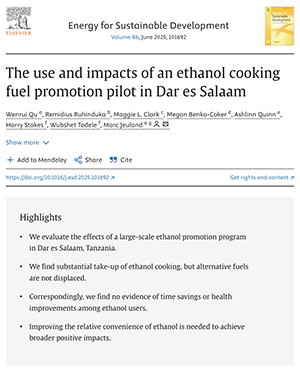
The Use and Impacts of an Ethanol Cooking Fuel Promotion Pilot in Dar es Salaam
The authors evaluated the effects of a large-scale ethanol cooking fuel promotion program in Dar es Salaam, Tanzania, and found substantial uptake of ethanol cooking. However, alternative fuels were not fully replaced under this scheme. The report concludes that improving the relative convenience of ethanol as a cooking fuel is needed to achieve broader positive impacts.
Sierra Leone Compact—Willingness to Pay for Electricity: Final Survey Report
This study focuses on assessing willingness to pay (WtP) for electricity among households and businesses—both those already connected to the grid but coping with unreliable supply, and those who are expected to gain access through future grid expansion or densification. This work provides a comprehensive valuation of the benefits of both new electricity connections and enhanced reliability for current users, as well as a rich dataset on energy use, perceptions, and expenditures in the study area that could be used for policymaking or future research.
Hazard Mitigation and Preparedness–Related Action and Opportunities in the US Congress
Federal policy and programs can play a critical role in helping communities—especially those with limited resources—ensure both security and economic vitality in the face of increasing threats from natural hazards. This summary builds on legislative history in the hopes that past priorities can provide some indication of who may be Congressional leaders and where opportunities lie for legislative action to help promote resilience against potential risks.