

Publications

A Standardized Definition of Rapid Evidence Assessment for Environmental Applications
Evidence assessment—identifying, evaluating, and synthesizing data and findings from previous studies—is important to inform environmental decision-making but can be slow and resource intensive. Users seeking efficiency have developed multiple definitions and methods for rapid evidence assessment (REA), raising concerns about consistency and rigor. To improve consistency and confidence in REA, the authors convened an international group of evidence users and researchers to define REA for environmental applications.
 , Jonah Busch, Sara Carlson, Jean-Jacques B. Dubois, Jacqualyn Eales, Edward T. Game, Robyn L. Irvine, Matthew Muir, Lydia Olander, Amina Pollard, Ana Porzecanski, Elizabeth Radke, Nicola Randall, Trevor Riley, Stephanie Ritchie, Nick Salafsky, Amanda Sigouin, Kara Stevens, and Caroline E. Ridley
Nine Things We Can Learn from Forest Accounts
To make good decisions, researchers and practitioners need high-quality, consistent, and accessible forest data. Pilot forest accounts are one of the first steps in tracking ecosystems services, demonstrating how accounts can be created using available data and determining what questions they can help answer.
Environmental and Ecosystem Services in Benefit–Cost Analysis
Recent federal updates and activities modernizing regulation have elevated the importance of ecosystem services and clarified guidance for accounting for their value. These changes underscore the crucial role of ecosystem services in federal benefit–cost analysis, provide clear entry points that make it simplify and enhance transparency for agencies and stakeholders to include ecosystem services in benefit–cost analysis, and document advances in the literature demonstrating that ecosystem services can be credibly and robustly included in such analyses.

Testing Factors that Enhance Private Participation in Payments for Ecosystem Service Programs Targeting Flood Mitigation
This report empirically examines the determinants of private participation in flood mitigation programs that use a payment for ecosystem services (PES) framework and suggests improved PES program designs and enhancements to their flood mitigation effectiveness. It offers evidence suggesting income from farming and potential participants' past experiences with PES programs may increase participation in programs aiming to mitigate flooding and that in turn could reduce economic damages from flooding impacts.
Biodiversity Is Not a Luxury: Unpacking Wealth and Power to Accommodate the Complexity of Urban Biodiversity
A positive correlation between wealth and biodiversity within cities is a commonly documented phenomenon in urban ecology that has come to be labeled as the “luxury effect.” We contend that both this language and this framing restrict our understanding of how sociopolitical power dynamics influence biodiversity within and across cities. We describe how the term “luxury” is not appropriately applied to describe patterns of biodiversity and how the pattern depends on the form(s) of biodiversity investigated.

Advancing Consistent Socio-Economic Monitoring of Coastal Ecosystem Restoration Through Collaborative Metric Development
Ecological restoration programs increasingly aim to provide socioeconomic and environmental benefits. However, monitoring of socioeconomic outcomes of these programs lags behind monitoring of ecological outcomes. Socioeconomic methods are less established, managers have less experience, and metrics used vary, stymieing evaluation and adaptive management. Here we demonstrate that logic models and stakeholder engagement can be used to identify core socioeconomic metrics across various types of restoration, focusing on coastal restoration in the Gulf of Mexico.

Evidence Library for Mangrove Degradation and Recovery
Mangrove ecosystems provide numerous benefits to both people and nature, including providing important habitat for wildlife species, nursery habitat for fish and shellfish, recreational opportunities, and protection for coastal communities. This evidence library synthesizes the scientific literature and expert knowledge to share information on what is known—and not known—about how storm-induced changes to mangrove ecosystems might impact mangrove ecosystem services.
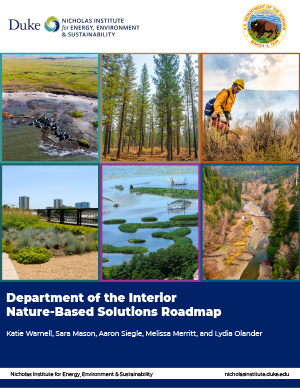
Department of the Interior Nature-Based Solutions Roadmap
This comprehensive resource, created in collaboration with the US Department of the Interior, is a first-of-its-kind reference for implementing nature-based solutions. Nature-based solutions are actions to protect, sustainably manage or restore natural or modified ecosystems to address societal challenges—including climate change—in ways that help people and the environment. Examples cited in the Roadmap range from urban stormwater and runoff management to prescribed burns to living shorelines to restoration of various ecosystems.
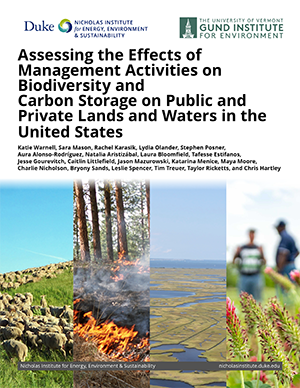
Assessing the Effects of Management Activities on Biodiversity and Carbon Storage on Public and Private Lands and Waters in the United States
Natural and working lands (NWLs) provide many benefits to people, including storing greenhouse gases (GHGs), supporting biodiversity, and generating other ecosystem services. Management of NWLs can influence their condition and function and therefore the benefits they provide. This project surveys the synthesis literature to assess how management actions on various types of NWLs affect biodiversity and GHG outcomes. This information can help to determine how to best manage these lands to contribute to both biodiversity and climate solutions in the United States.
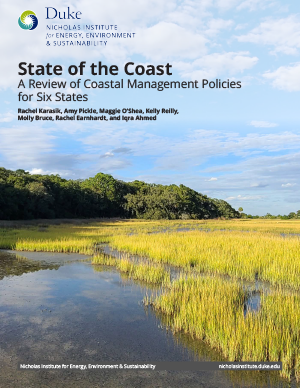
State of the Coast: A Review of Coastal Management Policies for Six States
This analysis of coastal habitat policy in six US states—California, Florida, Massachusetts, North Carolina, Texas, and Washington—aims to identify promising policy approaches for improved protection and restoration of oyster reefs, mangroves, salt marshes, and seagrass.